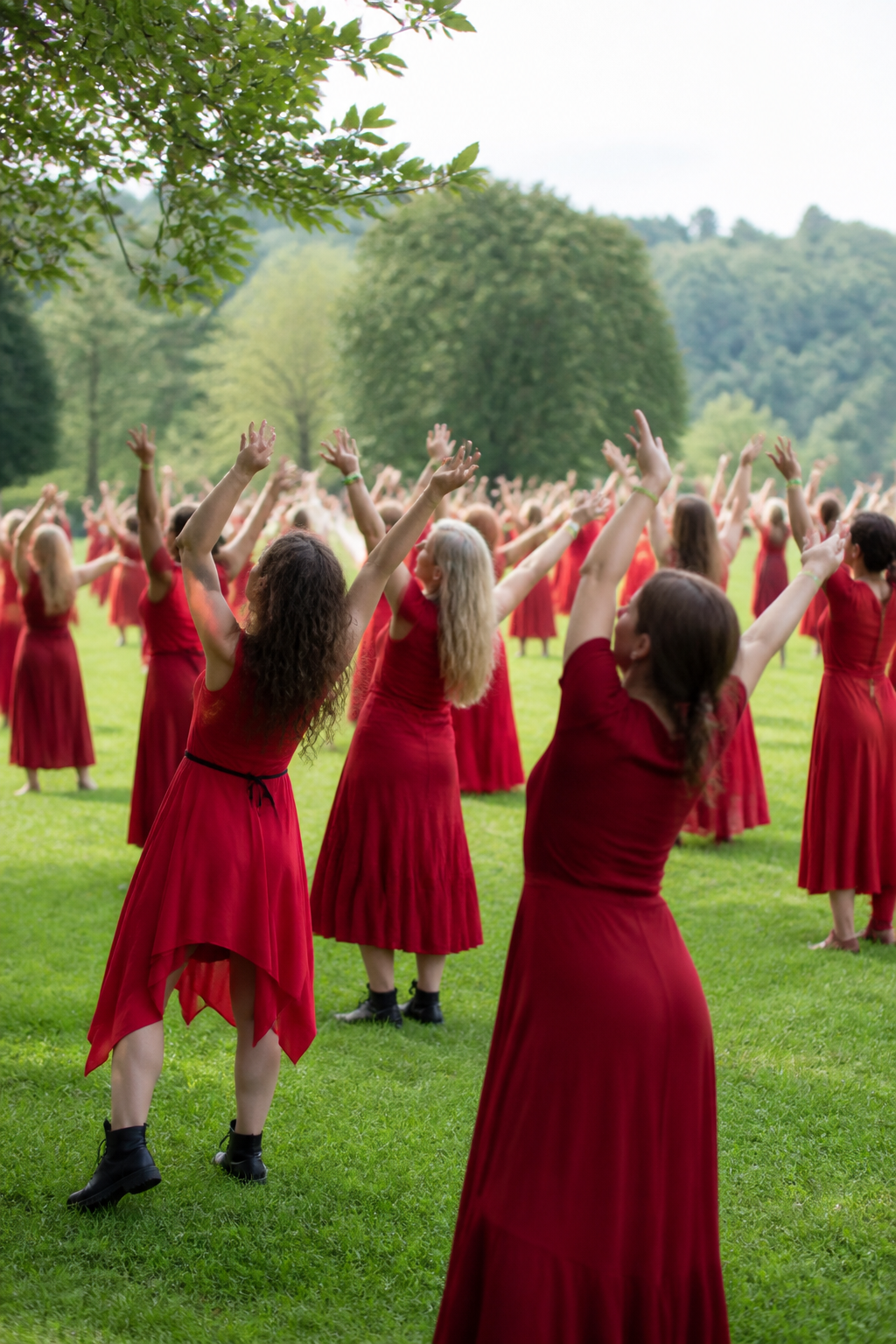
The first thing that strikes you is the queue for the toilets, which is entirely red. The second is the age range, which runs from about seven to somewhere past seventy. The third, if you have come alone and slightly dreading it, is that this is the least judgemental public gathering you are ever likely to attend, because everybody present is about to be visibly bad at the same thing.
It began in Brighton in 2013, when a local performance group taught a park full of strangers the choreography from the 1978 video for Wuthering Heights, the version with the red dress. It was meant to be a one-off. Within a few years the idea had been picked up in cities across Britain and well beyond it, running under the name The Most Wuthering Heights Day Ever, usually on the same summer weekend, usually raising money for a nominated local cause.
Why July, and why that particular song
The date is not arbitrary. Kate Bush was born on 30 July 1958. Emily Brontë, who wrote the novel the song is named after, was born on 30 July 1818. That coincidence has been a fixture of fan folklore for decades, and the events cluster around the weekend nearest to it.
The choreography comes from the promotional video, and its vocabulary is not conventional pop dance. She had trained with the mime and dance teacher Lindsay Kemp, and the movement shows it: it is theatrical, arm-led, and built from a small number of large gestures. That is precisely why several hundred untrained people can learn it in a morning. There is no footwork to speak of. There are shapes, and the shapes are big enough to be forgiving.
Keep the dancing rectangle clear with a tiny team by posting the volunteer at its edge to speak to crossers while the teacher stays focused on the crowd, using voice and light marking rather than fences that close the park. The approach treats marking the street performance area as something played and negotiated by voice, noticed only at the moment of crossing. The fragile moment is the start, when passersby do not yet know a show has begun and every path still crosses the rectangle.
The shape of the day
-
Around ten: arrival and registration
A gazebo, a folding table, a donation bucket and a volunteer with a clipboard. Most events ask for a small contribution to the chosen cause rather than an entry fee. You will be pointed at a patch of grass.
-
Half past ten: the routine, in sections
A teacher on a raised platform or the back of a van, with a microphone, breaking the piece into blocks and drilling each one. Expect an hour and a half of this. It is the part first-timers dread and end up enjoying most.
-
Around noon: the run-through
Everything joined up, at least twice, usually badly the first time. This is where you discover that nobody around you knows it either, which is the moment the day turns.
-
Early afternoon: lunch and changing
People eat on the grass and get into costume properly. Bring your own food; park catering is unpredictable and the queues at these things are long.
-
Mid afternoon: the performance
Two or three passes, filmed from every angle by a ring of onlookers. It lasts four and a half minutes and is over far faster than the preparation suggests.
-
Afterwards: the pub, inevitably
Several hundred people in red dresses walking through a British city centre towards a beer garden is a genuine spectacle and, for many attendees, the real event.
What to wear if a leotard is not for you
The canonical costume is the red dress from the video, and a great many people wear exactly that, bought cheaply or made. But the actual rule at every event we have attended is simply red, and the interpretations are wide: red skirts, red trousers, red shirts, red boiler suits, a red bedsheet in one memorable case. Nobody checks and nobody comments.
Practical advice from having got this wrong. Bare feet on a park lawn in July sounds romantic and finds every thistle and every piece of broken glass, so wear something soft you can move in. Take a hat and sun cream, because you will be standing in an open field for four hours. And take a bag you do not mind leaving on the grass, since there is nowhere to put anything.
- Something red that you can lift your arms fully in, and that you do not mind grass-staining.
- Soft flat shoes rather than bare feet, whatever the photographs suggest.
- Sun cream, a hat and considerably more water than you think.
- Cash for the collection bucket, because card readers at volunteer-run events are not reliable.
- Food, since you will be there five hours and the queues are long.
- A friend, if walking into a field of strangers alone is not your idea of a Saturday. It is fine either way.
If you are thinking of organising one

Several of the British city events are run by two or three people with no organisation behind them, so this is more achievable than it looks. The pieces are a public open space with permission from whoever owns it, somebody who can genuinely teach a routine to a crowd, amplification loud enough for an outdoor field, public liability cover, a first aid presence, and a nominated cause so that the money question has an obvious answer.
The two things that catch people out are the park permission and the sound. Public parks in Britain are owned by councils, trusts or private estates, and organised events on them require permission and often a fee and evidence of insurance. Apply months ahead. Outdoor amplification also needs far more power than an indoor system, and a teaching voice that cannot be heard at the back of a field turns a joyful morning into a frustrated one.
Beyond that, the discipline is the same as any other event we write about, and our planning checklist transfers almost directly. The difference is scale: an indoor evening for thirty forgives most mistakes, and an outdoor afternoon for four hundred forgives very few.
What it does for the rest of the year
We are interested in these days for a reason beyond the spectacle. They are, by a wide margin, the most effective recruiting event this fandom has. A significant proportion of the people who now turn up to small listening nights in hired rooms came to one of these first, discovered there were several hundred others, and went looking for something that happened more than once a year.
If that is you, the useful next step is not another festival. It is finding or starting something monthly and local, which is what the rest of this section is about: how to find a club that already exists, and how to start one when it turns out none does.
What usually goes wrong
- Arriving for the performance only. The rehearsal is the event. Turning up at two o’clock means standing at the back not knowing the routine, which is the one way to have a bad day.
- Bare feet. Every year, and every year the first aid volunteers are busy with it.
- Assuming the date. Cities schedule independently and dates move. Check the specific event rather than assuming the last weekend of July.
- Bringing a group without a meeting point. Mobile signal in a park with several hundred people on it is unreliable. Name a tree.
- Expecting to be good. Nobody is good. That is not the failure state, it is the format.