Three places account for most of the fan gatherings this country has held: a roofless farmhouse on the moor above Haworth, a chalk hill in Oxfordshire, and a statue in a London park. What follows is how each of them became a meeting point, how word travelled between fanzines, mailing lists and forums before any of this was easy, and why the customs outlasted every organiser who set them up.
What follows is a history of places rather than of people, which is the right way round for this particular fandom. The gatherings have always been organised around locations that mean something, and the locations have outlasted every organiser.
Haworth and Top Withens
The obvious pilgrimage, and the most enduring. Haworth is a village in West Yorkshire with a steep cobbled main street and the Brontë Parsonage Museum at the top of it, in the house where the Brontë sisters lived and wrote. Fans have been going there since the song that carries the novel’s title first put the place into pop music in 1978.
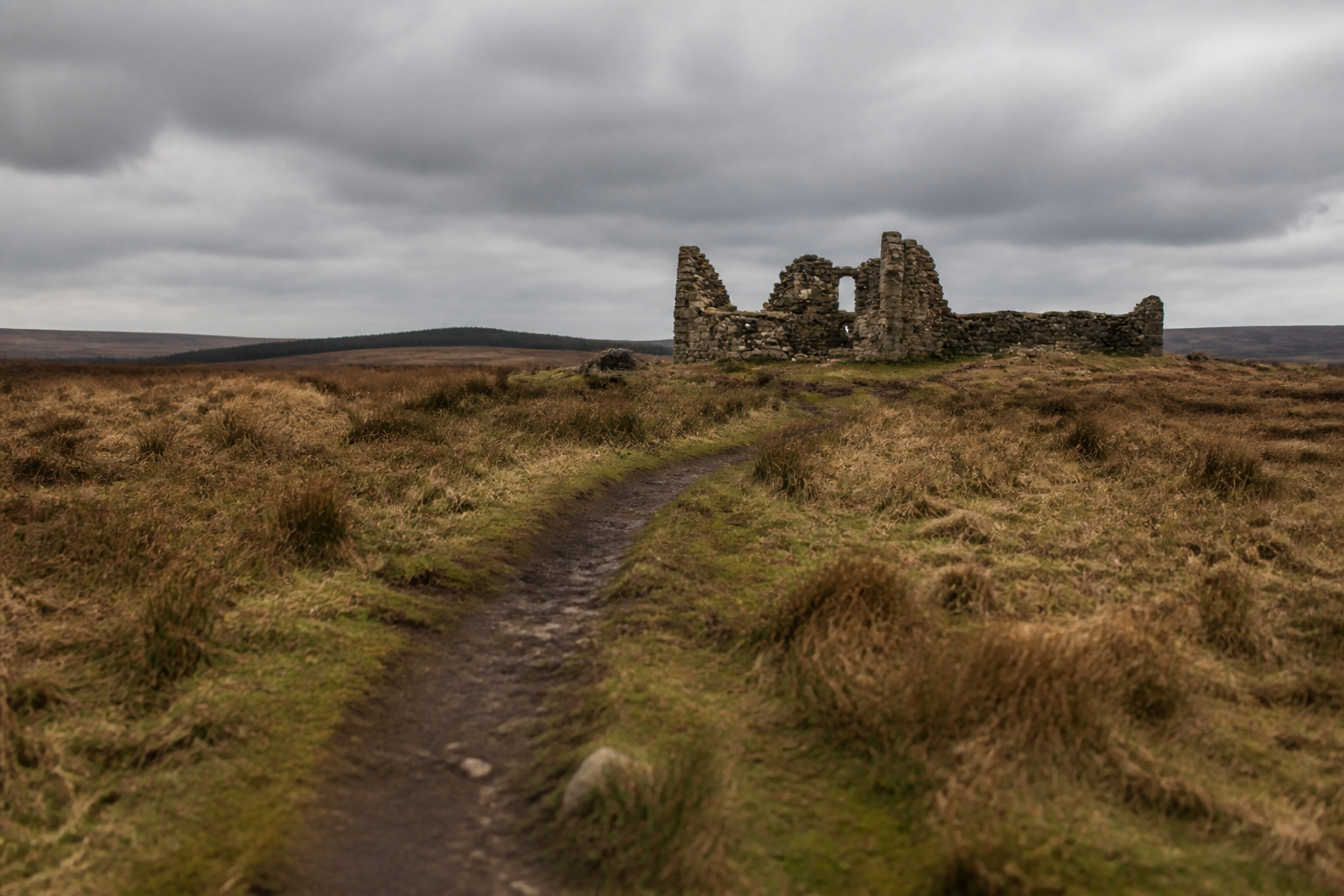
The actual destination is usually not the village but Top Withens, a roofless stone farmhouse on the open moor roughly three miles above it, reached on foot. A plaque placed there by the Brontë Society is admirably honest about the connection: the building itself bore no resemblance to the house described in the novel, but its situation on the moors may well have been what Emily Brontë had in mind. That careful sentence has not discouraged a single visitor in a hundred years.
The walk is genuinely exposed and the weather on that ridge changes fast. Every account of a Haworth gathering we have ever read contains a passage about somebody underestimating it, usually involving inadequate footwear and a great deal of horizontal rain.
The Keighley and Worth Valley Railway
The other half of a Haworth weekend, and a reliable fixture of these trips. The Worth Valley line is a five-mile preserved branch railway running from Keighley up the valley to Oxenhope, calling at Haworth on the way. It was closed by British Railways and reopened by volunteers in 1968, and it is the line on which the 1970 film of The Railway Children was shot.
Its usefulness to a gathering is practical as well as sentimental: it connects a mainline station to the village without a car, it runs to a published timetable, and it gives a group something to do together on the Saturday before the Sunday that everybody actually came for. Oxenhope, at the top of the line, has been a meeting point for fan groups for decades for no better reason than that it is the end of the track and there is somewhere to sit.
Uffington and Dragon Hill
Further south, and the location that surprises people who have not made the connection. The Uffington White Horse is a prehistoric chalk figure cut into a hillside in Oxfordshire, with a flat-topped mound called Dragon Hill below it. The 1985 video for Cloudbusting was filmed on that landscape, and fans have been walking up there ever since.
It is National Trust land, open, free and windy in every season. Nothing about a gathering there requires organising beyond agreeing a time and a car park, which is exactly why it persisted as a format through decades when nobody had a budget for anything.
Kensington Gardens
The London option, and the easiest of the lot to reach. Groups met at the Peter Pan statue in Kensington Gardens, a bronze unveiled in 1912 that has been a meeting point for Londoners ever since. The connection for this fandom runs through In Search of Peter Pan, from the second album in 1978.
A statue in a royal park is the ideal venue for a gathering with no money: it is free, it is findable, it is central, nobody needs permission to stand near it, and there are pubs in every direction afterwards. A surprising amount of British fan culture has been conducted on exactly those terms.
The thirtieth of July
The date that organises everything else. Kate Bush was born on 30 July 1958; Emily Brontë was born on 30 July 1818. Fans have marked the day informally since at least the 1980s, and the custom of gathering on or near it long predates any organised event.
It is worth understanding how modest these occasions usually were. A picnic on a hillside. A dozen people at a statue. A pub function room, a cassette, and somebody’s carefully sequenced compilation. The modern mass dances that fill parks every July are the descendant of that habit, not its origin, and our field guide to those days picks the story up from 2013.
How people found out about any of it
-
The fanzine era
Photocopied and stapled, sold by post, and edited by volunteers who took subscriptions in cheques and postal orders. The long-running British publication in this fandom was HomeGround, which carried news, letters and event notices from the early 1980s onwards and functioned as the de facto noticeboard.
-
The mailing list era
From the mid 1980s the discussion moved onto early internet mailing lists, of which the best known in this fandom took its name from the 1985 album. It reached an international readership years before the web existed and is one of the older music fan communities online.
-
The web forum era
From the late 1990s into the 2000s, message boards took over. This is the period that produced the year-by-year gathering write-ups that many people still remember, and the reason a surprising number of dead links to sites like this one are still out there.
-
The social media era
From roughly 2010, organising moved onto general-purpose platforms. Reach went up and permanence went down: a gathering announced on a social platform in 2014 is now substantially harder to research than one announced in a stapled fanzine in 1994.
-
The mass event era
From 2013, the summer dance days, which are the first form of gathering in this fandom’s history to be visible to people who are not already part of it.
What the old model got right
- Anchor the event to a place with meaning, and the event survives every change of organiser.
- Choose somewhere free and public, and you never have to fill a room to break even.
- Fix a date that already exists rather than inventing one, and nobody has to be persuaded when it is.
- Build the weekend around a walk or a journey, because shared travel makes friends faster than a shared room does.
- Write it up afterwards, at length, with photographs. The write-up is what recruits next year’s attendees.
- Keep it small enough that one person can still hold the whole thing in their head.
That last point is the one modern organisers most often lose. The gatherings that ran for a decade or more were rarely the ambitious ones. They were the ones somebody could repeat next year without asking anyone’s permission, which is the same conclusion we reach in the starting guide from an entirely different direction.
What usually went wrong, then and now
- The organiser burned out. Almost every dormant fan gathering in this country stopped because one unpaid person got tired, and nobody had been trained to take over.
- The record disappeared. Fanzines survive in archives; forum posts and social media events largely do not. Write things down somewhere you control.
- The weather was underestimated. Yorkshire moorland and open Oxfordshire downland in any month at all.
- The site was treated as a venue. Museums, heritage sites, preserved railways and National Trust land all have rules about organised groups. Tell them you are coming.
- Nobody set the next date. The same failure in 1997 as in 2026.
If you are planning a trip to any of these places, treat them as what they are: a working village, a fragile scheduled monument, a volunteer-run railway and a public park. They have absorbed forty years of visitors with considerable grace, and they will absorb forty more provided people keep to the paths and take the litter home.