Most fan gatherings die in the group chat. Somebody suggests it, four people say they would definitely come, a fifth asks whether September is better than August, and the thread goes quiet for a year. The cure is unromantic: pick a date before you pick anything else, and tell people the date out loud.
What follows assumes you are in the United Kingdom, that you have no budget to speak of, and that you have never booked a venue in your life. That was our position too. The first evening we ran had eleven people in it, including the two organisers and somebody’s partner who came for the lift home.
First, decide what kind of evening it actually is
Almost every successful small gathering is one of four things, and the trouble starts when organisers try to be three of them at once.
- A listening night. One record, played properly, start to finish, with the lights down and a short introduction. Cheapest and easiest to repeat.
- A talk with an audience. Somebody speaks for forty minutes on a subject they know well, then questions. Needs one confident speaker and a working microphone.
- A social with music. Drinks, a playlist, no formal programme. The easiest to attend and the hardest to make memorable.
- A doing thing. A rehearsal, a dance workshop, a records-and-swap table. People leave having made something, which is why these build the strongest regulars.
Pick one. Write it in a single sentence you could say to a stranger at a bus stop. If the sentence needs a comma and the word “also”, you have picked two.
The eight week sequence
-
Week one: fix the date and the format
Choose a weekday evening or a Saturday afternoon. Avoid bank holiday weekends and the second half of December. Announce the date to a small circle before you have a venue, because the date is what makes people believe it is real.
-
Week two: find three possible rooms
Community centres, village halls, scout huts, library meeting rooms, pub function rooms, arts centre studios. Ring all three. Ask the questions in the checklist below, then take the cheapest one that answers them well.
-
Week three: book, pay the deposit, sort the licence question
Get the booking in writing, even if it is only an email. Ask the venue directly whether their music licence covers your event, and ask whether their public liability insurance covers hirers.
-
Weeks four and five: publish it and start telling people
You need one page on the open web with the date, the address, the start and finish times, the price, the step-free access situation and a way to reply. Everything else you post should link back to that page.
-
Week six: sort the kit and the running order
Test the sound in the actual room, not in your kitchen. Write a minute-by-minute running order, including the boring parts: doors open, welcome, main event, break, finish, out by.
-
Weeks seven and eight: remind, confirm, arrive early
Send one reminder five days before and one the morning of. Arrive ninety minutes early. Something will be locked, missing or double booked, and ninety minutes is what turns that into an anecdote rather than a disaster.
Choosing a room that will not sink you
The instinct is to book somewhere impressive. Resist it. A room that is two thirds full at forty people feels triumphant; the same forty people in a hall built for three hundred feels like a wake. Under-book the space, always.
Ask the hall these before you pay anything
- What is the hourly rate, and does it include the time we need for setting up and clearing away?
- Is there a separate charge for the kitchen, the projector, the PA or the chairs?
- Do you hold a music licence that covers recorded music played to our guests?
- Does your public liability insurance extend to hirers, or do we need our own cover?
- Is there step-free access from the street, and an accessible toilet?
- Where is the nearest parking, and what is the last useful bus or train home?
- What time must we be out, and what state must the room be left in?
- Who holds the key on the night, and what is their mobile number?
That last question has saved us more evenings than any other. A caretaker who is not answering the phone at half past six is the single most common way a first gathering fails.
The money, told honestly

A small evening in a hired hall in the UK typically costs somewhere between the price of two cinema tickets and a modest weekly shop, once you have paid for the room and bought tea, milk, biscuits and a couple of packs of paper cups. Rates vary enormously by region and by whether the hall is run by volunteers or by a council.
Cover it in one of three ways. Charge a small amount on the door and say plainly what it pays for. Ask for voluntary contributions in a tin and accept that you will be a little short. Or fund the first one yourself, treat it as the cost of finding out whether anyone comes, and start charging from the second.
Do not take money before you have a confirmed booking. Refunding fourteen people because the hall double booked you is a miserable way to spend a Tuesday.
Telling people it exists
Publicity for a first gathering is mostly one to one. Message twenty people individually rather than posting once to two thousand. The individual message converts; the broadcast does not.
Beyond that, the routes that still work in this country are unglamorous and free: the noticeboard in the library and the community centre, the local independent record shop, a listing in the parish or town newsletter, the events page of the local paper’s website, the relevant online forums and groups, and the nearest university’s societies office if term is running. Print twenty small cards and leave them where the right people already stand.
Say the price, the finish time and the access arrangements in the first three lines of everything you write. People decide on logistics, not on enthusiasm.
The first night, and then the second
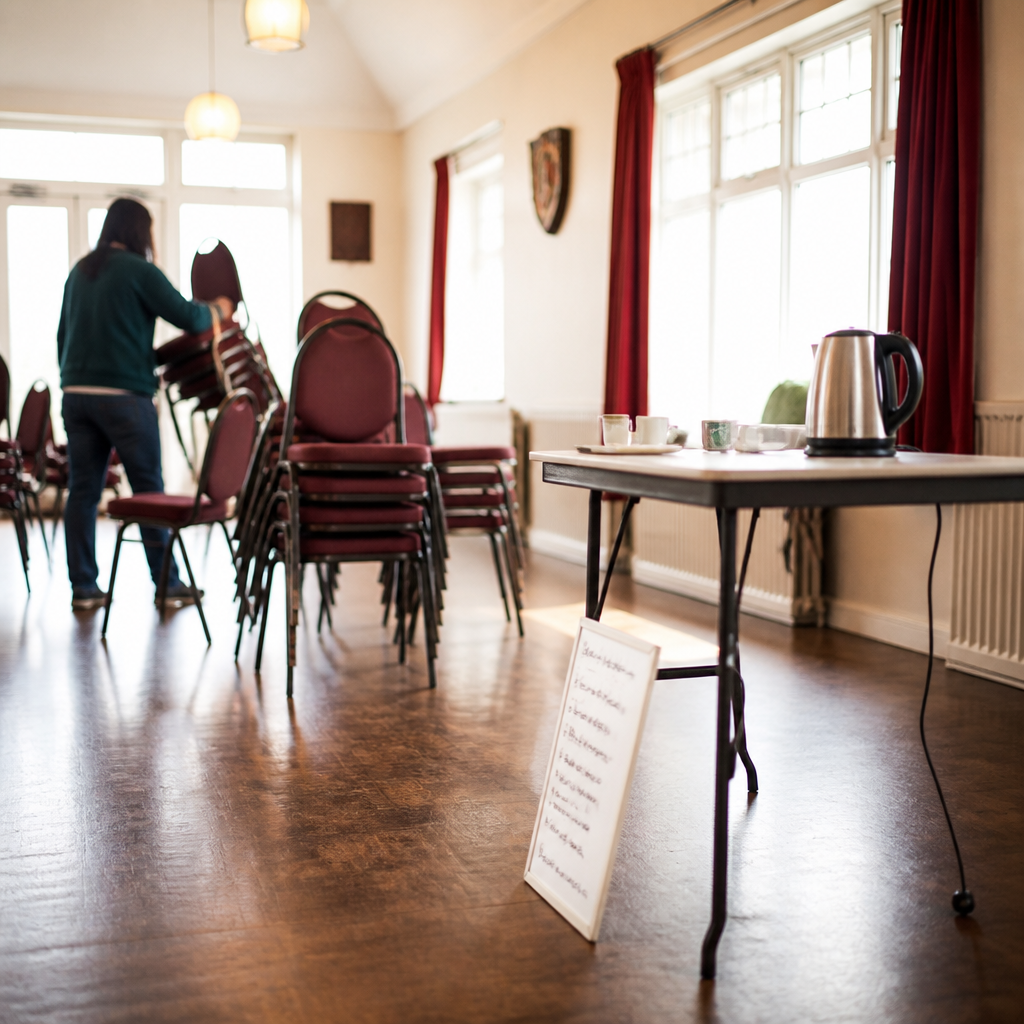
Put fewer chairs out than you expect to need and add more as people arrive. A half-empty circle is depressing; carrying extra chairs in front of a growing crowd is the best possible sign.
Start no more than ten minutes late. Say who you are, how long it will run, where the toilets are and when it ends. Then do the thing you promised, finish on time, and announce the next date before anybody leaves. That last sentence is the entire difference between an event and a series.
What usually goes wrong
- One person carries everything. Split the roles from the start: room and key, money and door, programme, publicity. Four small jobs survive a bad month; one big job does not.
- The sound is wrong. Halls are reverberant and unforgiving. Bring your own small system if you can, and test it with the doors closed and the chairs out.
- Nobody knows when it ends. Publish a finish time. Attendance rises when people know they can leave.
- Access is an afterthought. If you cannot get a wheelchair through the front door, say so before people travel, and start looking for a different room.
- The second one never happens. Book the next date while the first is still fresh, ideally before you have tidied the chairs away.
If you get through all of that and eleven people turn up, that is not a poor result. That is a fan gathering. Ours has run for years on exactly that arithmetic.