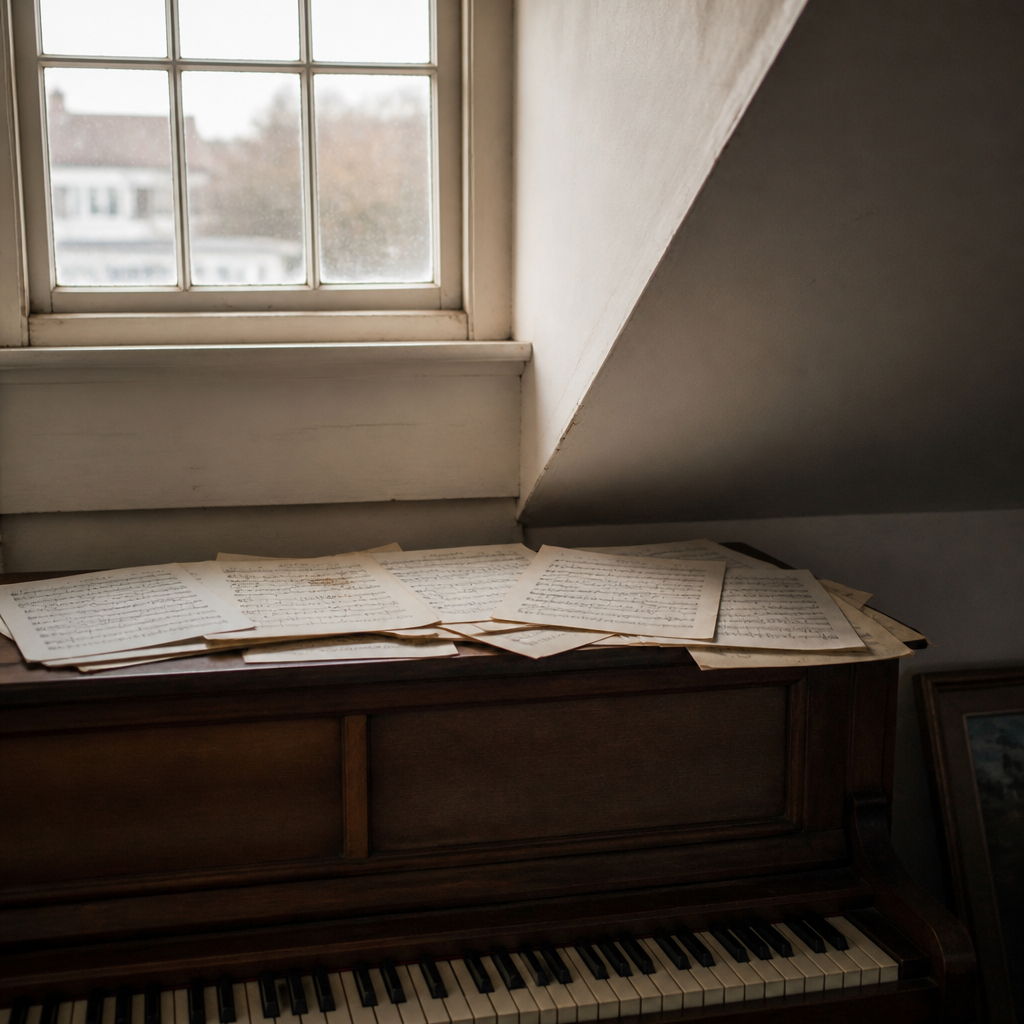
The number that never quite loses its force is this one: the songs on this record were largely written between the ages of about thirteen and sixteen. Not polished at that age and finished later. Written. The catalogue she was drawing on by the time she went into the studio ran to something like two hundred songs, accumulated by a schoolgirl at a piano in Kent who had not yet performed in public.
What happened next is the part that gets flattened in the retelling. A demo tape reached David Gilmour of Pink Floyd through a family connection, and in 1975 he paid for proper studio sessions so that the material would be heard as it deserved. EMI signed her on the strength of it, and then did something almost unheard of: they left her alone for two years to grow up, write more and learn her craft, rather than rushing a sixteen year old onto television.
The two years nobody talks about
She did not spend them waiting. She studied dance and mime with Lindsay Kemp, whose vocabulary of large theatrical gesture runs through everything she did afterwards, on record sleeves, in videos and eventually on stage. And in 1977 she formed a band with musicians she knew and played pubs around south east London, working through covers and her own material in front of rooms that had no idea who she was.
That detail matters more than its length in the story suggests. A great deal of the mythology treats her as an apparition who arrived fully formed on television in January 1978. She had in fact done the ordinary apprenticeship, in the ordinary rooms, in front of the ordinary indifferent Tuesday night audience. Anyone who has run a small night in a pub function room will recognise the training.
The argument about the first single
EMI wanted to lead with James and the Cold Gun, which is the most conventionally rock-shaped thing on the album and the obvious commercial choice. She wanted Wuthering Heights, which is in an extremely high register, is about a ghost at a window, and sounds like nothing that had been on Radio 1 before.
She won. She was nineteen, unreleased and had no leverage whatsoever, and she won. The single entered the chart in January 1978, reached number one in March and held it for four weeks. It made her the first woman to top the UK singles chart with a song she had written herself.
We keep returning to this episode because it is the founding fact of the whole career. The pattern that produces the home studio in 1983 and the seven-part suite on Hounds of Love in 1985 is already fully present in a teenager refusing her label’s A and R department in 1977.
Six songs to start with
- MovingOpens the record with whale song and a dedication to her dance teacher. An unusual way to begin a pop debut, and a statement of intent.
- The Man with the Child in His EyesRecorded in 1975, when she was sixteen. Released as the second single and a top ten hit. The vocal is the sound of somebody who has not yet been told what a pop record is meant to be.
- Wuthering HeightsWritten in a single night after she caught the closing minutes of a television adaptation. She shares a birthday with the novel’s author, which fans have never stopped enjoying.
- KiteThe one we borrowed half our name from. Loose, joyful, faintly ridiculous, and the clearest indication on the record of how much fun she was having.
- Them Heavy PeopleA song about teachers and mystics with a reggae lilt, and probably the best entry point for anybody who finds the higher register difficult.
- The Kick InsideThe closing title track, drawn from a traditional ballad of incest and suicide, sung with complete composure. Nineteen years old.
What it actually sounds like now
Andrew Powell produced, and the arrangements are of their period: warm, orchestral where it counts, played by capable session musicians, and considerably more conventional than the songs underneath them. That gap between conservative production and unconventional writing is the album’s defining tension, and it is why the record divides listeners who come to it after the later work.
The voice is the other obstacle. In 1978 the high register was treated as a novelty, and it was widely imitated in an unkind way. Give it two or three listens rather than one. What sounds like affectation on first contact reveals itself as extremely precise control, and the lower, warmer voice that most people now associate with her was already available. She simply chose not to use it here.
The tour that only happened once
The Tour of Life ran through April and May 1979, twenty four dates around Britain and Europe, opening in Liverpool and finishing at the Hammersmith Odeon in London. It was extraordinarily ambitious for a debut tour: dance, costume changes, magic, poetry, a fully staged production rather than a band and a microphone stand.
The technical legacy is the headset microphone. She needed to sing and dance simultaneously, no suitable equipment existed, and one was improvised for her using a wire coat hanger and a radio mic. Versions of that idea became standard equipment for every performer who dances, which is not a small footnote.
The tour was also marked by the death of a member of the lighting crew in an accident during its early dates, and she later played a benefit for his family. She did not perform a full concert of her own again for thirty five years, until the residency covered in our essay on Before the Dawn.
If you are playing it to a room
This is the easiest of her records to programme for a mixed audience, because almost everybody has a way in through one song, and it is the one we suggest for a first listening night where you are not sure who will come.
Two practical notes from having done it. Say something about the teenage songwriting before you start, because it changes how people hear the whole side and it is the fact that converts sceptics. And do not skip The Kick Inside at the end to finish on something cheerful. The closing track is where a polite room goes quiet, and that silence is the reason to hold the evening at all. Our guide to starting a gathering covers the mechanics of getting people into the room in the first place.